Tuesday, September 14, 2010

A Month of Noir Day 14 - Lady in the Lake

Directed and "starring" Robert Montgomery as Raymond Chandler's Philip Marlowe, Lady in the Lake is definitely a very interesting picture.  Touted as "a startling and daring new method of story telling---a milestone in movie making..." the film certainly delivers.  Could it have been just a gimmick?  Sure, but it works.

Lady in the Lake was filmed almost exclusively from the point of view of Philip Marlowe, with the camera being his, and the viewers eyes.  For you video game junkies out there, it's like a first person shooter game, but for the rest of you, it's a chance to view a case through the eyes of the detective.

From a filming standpoint, it had to have provided some challenges.   The actors had to talk to the camera, which is a bit disconcerting at first, but soon becomes normal.  And clues couldn't be shown in any obvious manner.  They are there, but not easily noticed, which gives the viewer a chance to play at being Marlowe.  A few times I know I wanted to yell "Look to the left" or some other direction.  Frustrating.

So is the film any good?  Yes and no. 

Montgomery, rarely seen on camera, does an excellent job with Marlowe's voice.  He does a good job of expressing Marlowe's emotions without the use of his face, a tough task well handled.

As for the story, it's a good old fashioned detective yarn, the type of story you can expect from Raymond Chandler.  Marlowe, on the pretense of having a story he wrote becoming published, meets with a female editor, Adrienne Fromsett (Audrey Totter), who hires him to find Chrystal Kingsby (Ellay Mort), the wife of publisher Derace Kingsby(Leon Ames).  She's been missing for a few months and her husband hardly seems worried.  But Fromsett believes she's run off with a man.  So why does she want Chrystal to be found when her husband couldn't be bothered otherwise?  Marlowe sure she wants to be the new Mrs. Kingsby, and that can't happen with Chrystal still around.  Adrienne is more than happy to point Marlowe in a few directions, and each is met with angry, unhappy people and murder, including the "lady in the lake."

My only complaint is from personal opinion, and not fault of the filmmakers.  I enjoy the lighting of film noirs, the dark shadows and tricks that can be made when using a high contrast light source.  Those are rarely present in this film, which is understandable.  Should Marlowe spend too much time in the dark, as viewers we'd be looking at nothing but a black screen.  So the story is pretty well lit.  Not my favorite style choice, but it suits the needs of the film well.

Montgomery pulled off a pretty neat trick with this story, and that gets him a few extra points with me.

Rating: 4 out of 5 stars.

Monday, September 13, 2010

A Month of Noir Day 13 - Can't Escape Comics

A few short days ago, the movies at the ATP New York were all curated by the Criterion Collection.  Of particular interest to crime buffs, was the the Saturday schedule, Criterion Crime Wave curated by Jim Jarmusch.  The following films were shown

-Underworld
-The Killing
-Le Doulos
-Gomorrah
-Brute Force
-A Colt is My Passport
-Touchez Pas Au Grisibi
-Kiss Me Deadly

Other films shown during the weekend included Repulsion and Night of the Hunter

And while a day of these films is always cause for celebration, check out these posters created specifically for the show.  

Brute Force by Scott Morse


Touchez Pas Au Grisibi by ?


The Night of the Hunter by Matt Kindt


A poster was created for each film shown at ATP, but this is all my searching has been able to uncover.  Hopefully Criterion will offer these beautiful pieces of art for sale in some print form.


Sunday, September 12, 2010

A Monthy of Noir Day 12 - More and More Mitchum

I had fun doing this last week with Bogart and the more I thought about it, the more I wanted to spotlight a few other stars of the genre.  After all, September only has 30 days, so there is no way I was going to get around to viewing all of these movies. 

Today I give you my  personal favorite film noir star, Robert Mitchum.  Night of the Hunter and Cape Fear are two of my favorite films from his career, but since I've already seen them, they weren't going to be mentioned this month, which would be a shame.  They are classic, almost required viewing.  Her are the trailers for those two films along with a couple others.   Be on the lookout for more Mitchum later this month.

Night of the Hunter


Undercurrent


Where Danger Lives


His Kind of Woman


Cape Fear

Saturday, September 11, 2010

A Month of Noir Day 11 - Kiss Me Deadly


Kiss Me Deadly started with such promise.
A barefoot woman runs breathlessly down a dark highway, barefoot, wearing only a trench coat.  Cars fly past her, despite her best attempts to get them to stop and help.  As a last ditch effort, she stands at the dead center of the road and dares it to hit her.  It swerves to miss her and ends up on the side of the road.

Mike Hammer(Ralph Meeker) isn't pleased.  She gets in the car, and against his better judgement, agrees to give her a ride to the bus station.  Credits roll as Nat King Cole sings "I'd Rather Have the Blues," the woman sobs, and Hammer continues driving.

He didn't want to pick up this woman, but as she states, if she's just been sticking her thumb out, he wouldn't have stopped.  His mood isn't the best, as it rarely is in this film.  Instead of possibly comforting this distressed woman he threatens to throw her off a cliff.  At least he pretended to be her husband when stopped by a police roadblock.  Turns out his passenger escaped from an asylum.

"Get me to that bust stop and you can forget you ever saw me."

Guess what?  They never make it to the bus stop.  A car cuts them off and snatches them.  Christine (Doris Leachman) is tortured by the three assailants while Hammer is out cold.  They are placed back in Hammers car and pushed off a cliff.  He survives, she doesn't.

I'll give Hammer this much, for being such a prick, he at least wants to enact vengeance on Christine's killers.  In this film, Mike is not an honorable man.  He's a PI that specializes in divorce cases, in which he pimps his girlfriend/associate Velda (Maxine Cooper) out to seduce men, then takes pictures.  He's not above turning the same trick himself, and then plays the husband against the wife.  It's despicable, and even worse, he seems to really enjoy it.

I understand completely that Hammer is not a nice guy.  Even in the books he's written as a brutal and misogynistic man, but Meeker really plays up the narcissistic tendencies.  Perhaps it's because he's a bit more handsome then hardboiled, but every girl he meets just wants to make out with him.  And the violence!  Meeker gets this wild look in his eyes every time he slaps a man around.  That's right, he throws more slaps than punches, whether they be an actual bad guy or someone just not helping him fast enough.  There is glee in those eyes, and that's just slimy.

But the bad acting doesn't stop with just him, as this film is full of annoying characters.  I was openly hoping his mechanic Nick (Nick Dennis) would become a casualty, and mystery woman Lily (Gaby Rodgers ) portrayed one of the worst femme fatales of all time.  Her delivery was more wooden than a baseball bat and equally as dull.

At the 45 minute mark, I was dying for this film to be over, and nearly wept when I realized there was still another hour to go.  Thirty minutes could have been excised from this film easily and made it more tolerable.  The only highlight was a second crooning of "I'd Rather Have the Blues" at a nightclub by Madi Comfort as Mike Hammer drank himself into unconsciousness.  At that moment I envied him.

It's said that Mickey Spillaine was not happy with the adaptation by director Robert Aldrich and screenwriter A.I. Bezzerides. I can understand his anger.

Rating : 2 Stars out of 5

Friday, September 10, 2010

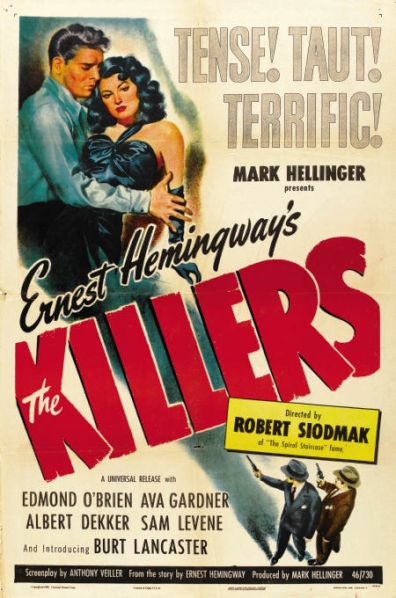
A Month of Noir Day 10 - The Killers (1946)

When I decided to do a month long review of film noir, I told myself that I wouldn't review any films I'd already seen. This would be a chance to discover some new stuff, and not just rehash the old. Part of me is a bit sad because that means I can't rewatch In a Lonely Place or Night of the Hunter, but today I'm finding a bit of a loophole.

The Killers (1946) is one of my favorite all time noirs. Based on a short story by Papa Hemingway (+1), directed by Robert Siodmak (+2) and starring Burt Lancaster and Eva Gardner (+3 and 4), it tells the tale of The Swede (Lancaster), an ex-boxer who has gotten involved with mobsters.   Two hitmen find him, kill him, and from there we learn about who he was through flashbacks.

There.  That's the last I'm saying about the film itself, because today I'm reviewing the Criterion Collection edition of The Killers that made it's way into my mailbox a short time ago.

This is what all DVD should aspire to be.  Not only does the film look and sound great, but the extras are educational, and most importantly, interesting.

Stuart Kaminsky on The Killers
It's nothing more than six-time Edgar nominee and winner talking about the film, but the guy knows his stuff.  Way more interesting than looking up the info on Imdb or Wiki.

Biographies
While most discs will give the bios on the stars and/director, Criterion gives information on seven actors/actresses, the director and the composer Miklos Rozsa.

Exploitation
Publicity stills, Production Stills, Behind-the-Scenes, Original Press Book, Original Advertising, and pictures of the Winter Garden Theater in NYC

Source and Adaptations
Hemingway's short story as read by Stacy Keach
Andrei Tarkovsky's The Killers.  Tarkovsky's first short film, which was made while still in a Russian Film school.
Screen Director's Playhouse, broadcast on June 5, 1948

Notes on Film Noir
A case study of noir, written by Paul Schrader (Taxi Driver) and published in FILM COMMENT in 1972
 -Introduction
 -War and Post-War Disillusionment
 -Post-War Realism
 -The German Influence
 -The Hard-Boiled tradition
 -Stylistics
 -Themes
 -Three Phases of Noir
 -Neglect of Noir

And for last Siodmak Trailers
 -Son of Dracula
 -Cobra Woman
 -The Killers
 -Cry of the City
 -Criss Cross

This disc is not just a classic of film noir, it is the standard for which all film noir releases should measure themselves up against.  One could easily spend an entire afternoon doing nothing but meticulously going through each and every special feature.

But that's not all.  There is another disc.

Disc two gives us the 1964 edition of the film along with the following special features.

Reflections with Clu Gulager, star of the 1964 version


Excerpts from A Siegel Film pertaining to the making of the movie

Production correspondence including memos from Don Siegel, broadcasting standards reports and casting suggestions

Production and publicity stills with actor biographies, rare behind-the-scenes stills gallery, and advertisements

Notes by Geoffrey O’Brien (Hardboiled America: Lurid Paperbacks and the Masters of Noir)

Here's hoping Criterion continues to mine the old classics and gives them an equally amazing treatment.

Thursday, September 9, 2010

A Month of Noir Day 9 - I Wake Up Screaming

Let's get the important stuff out of the way first. Yes, we do get a pretty good look at those famous Betty Grable legs, but honestly, just look at the poster to the left if that's what you're after. Better shot than the mostly below the knee action you get watching the film. Forgive me if I don't get too excited. I hit puberty during the gratuitous nudity 80's, but I can appreciate what a shot of her lovely legs must have meant to both men and boys in the 40's. But hopefully you are watching the film for another reason, perhaps because it's a damn fine film.

On a gentleman's bet, Frankie Christopher (Victor Mature) decides that he can take a "plain" hash house waitress (Carole Landis) and make her famous in New York's high society.  He's a promoter, and he can make a star out of anyone.   It doesn't hurt that Vicki Lynn is incredibly attractive and in on it.  Unlike most movies where a guy dates a girl on bet, she is actually in on it.  She would love to be famous.

It's a plan that works well.  Frankie gets her to meet all the right people and go to all the right places.  Soon her picture is in the paper and people come calling, including Hollywood.  But before she is able to leave, she turns up dead.

Feeling that he might have not wanted to lose a meal ticket, the police, and especially Detective Ed Cornell (Laird Cregar) place the blame squarely on Frankie's slick shoulders. 

At this point, director Bruce Humberstone pulls out his bag of tricks and shows some real skill.  Both Frankie and Vicki's sister Jill Lynn (Betty Grable) are brought in for questioning.  Each of them tells a side of the story, picking up where the other left off, but told separately and in flashback.  It's a good storytelling device and it works well.

What also works is the staging of the interrogations.  Frankie sits in a dark room, barely lit by a small but bright light.  He's very visible, but everything else is in shadows, allowing cinematographer Edward Cronjager to play with the lighting of characters.  Cronjager also uses his impressive skills when shooting the second interrogation room, which appears to be some sort of cage, and casts some great shadows upon the actors.

Don't let me forget the actor.  It's been said that Victor Mature once claimed to have never acted in any of his movies.  I've seen a few, and I believe him.  Other than a sly grin and a pair of expressive eyebrows, he offers very little to the picture.  His performance is likable, but hardly memorable.

Both Grable and Landis do exactly what is needed of them.  Landis has the better role to show off her beauty, and she plays a woman looking for fame rather convincingly.  She's rather charming, and it's easy to see why the men in the film want to help her.  Grable plays the "plain" role, which could be laughable.  She's too attractive, but she downplays her beauty as best as possible and handles her rare dramatic role quite capably.  Her growing interest in Frankie is subtle and it works.

But the real scene stealer of the film is Laird Cregar as the detective who seems a bit too obsessed with finding Vicki's killer.  He's a tall, imposing figure, and the director does a great job of showcasing that by always having him in close proximity to the other characters.  His clothing is always darker than everyone else and he's shot in shadows for most of the film, which I suspect is the directors way of letting us know something isn't quite right with this guy.  The hints are nice, but unnecessary, as Cregar uses his size and voice to alert the audience of his motives and intentions.  He oozes creepiness, and it's obvious, thanks to an earlier and unnecessary shot, he's got a vendetta.

"I don't scare you enough to commit suicide, but I worry you just the same."

Rating: 4 out of 5 Stars.


Wednesday, September 8, 2010

A Month of Noir Day 8 - He Walked By Night

This is a true story
It is known to the Police Department of one of our largest cities as the most difficult homicide case in its experience, principally because of the diabolical cleverness, intelligence and cunning of a completely unknown killer...The record is set down here factually---as it happened.  Only the names are changed---to protect the innocent.

A well dressed man walks down a city street, bathed in darkness, yet still casting a shadowy figure along nearby surfaces.  He stops at an electronic store.  At this time of night, it is, of course, closed, ant that is precisely why he has chosen to stop now.  The man pulls a lockpick kit from his coat pocket and goes to work.  Unfortunately for him, an officer, off duty and on his way home to his wife, drives by.  He pulls his car alongside the man as he attempts to walk away.  When asked for identification, he instead pulls a gun and emptys a few rounds into the officers car.  He attempts to get in a car and drive away, but the officer, in a final heroic act, crashes his car into the getaway vehicle, forcing the murder to escape on foot, leaving behind some guns and a clue, a navy issued radio.

As the detectives arrive on scene, they interview witnesses.  It seems the officer was able to describe the man before he died.  The police begin a dragnet, pulling in everyone on the street that matches a possible description.  It comes up empty.

The criminal, one Roy Morgan, is no ordinary thief.  It seems he steals electronic equipment, improves their design, then sells them on consignment to a local electronics rental company, Reeves electronics.  Mr. Reeves adores Morgan, complimenting his intelligence and offering him a job.  When Morgan refuses, Reeves tells him of a customer who is interested in a television projector that he once mentioned.  Morgan tells him it will be finished tomorrow, which it is.  Reeves brings in the customer, only to find out the projector was stolen from the very man who intended to buy it.  He notifies the police.  At last a solid lead.

Soon a trap is set up, but Morgan is too smart.  He shoots his way out, paralyzing one of the officers, and escapes.  In order to avoid future detection, he changes his MO and starts robbing stores, while changing his apppearance.

A strong aspect of He Walked By Night is the level of investigation the police bring to this case.  Instead of relying on informants or other familiar tropes of the genre, these officers use laboratory work as well.   Enter the most important part of the film, Jack Webb as Lee Whitey, an early form of a CSI lab tech.  Using up to date technologies, Whitey is able to discover what our criminal looks like, and more importantly, that the gun being used in the robberies is the same that shot the officer. 

The police begin another dragnet, and soon a local milkman offers them an address that proves correct.  As they attempt to arrest him, Morgan once again escapes, this time into the underground spillways of Los Angeles.  They decend upon him, and in a memorable looking shoot out, they get their man.  Dead.

So why was Jack Webb so important?  It is told that during this movie, Webb struck up a friendship with technical advisor, Detective Sargeant Marty Wynn, and was inspired to create first the radio show, then the television program, DRAGNET.  It's not a hard story to believe, as many aspects of this movie, from the opening title card, the the voice over narration, would become staples of that memorable and groundbreaking show.

It's also of interest that this might have been the first noir film I've seen where the criminal is treated as a mastermind.  He's highly intelligent, cunning and adaptive.  He's aware of police procedures, as is evidenced by him listening in on a scanner, and changes his methods accordingly.  He can pick locks, improve electronics, can handle a gun, disguise himself, and actually perform field surgury on himself once he is shot.  Truly an exceptional criminal.  Yet he is still caught be even better police work.

Even if the film wasn't as good as it was, I still would have enjoyed it thanks to it's incredible title. 

Rating: 4 Stars out of 5, with an extra credit star because it helped create DRAGNET.